Learning Vietnamese — The Most Beautiful Language to Learn, the Hardest to Master
Six distinct tones, a Latin alphabet modified with 29 specific letters, and a pronoun system that alters the word "I" based entirely on who you are speaking to — but it is not impossible
Learning Vietnamese typically begins with a single, brutal question that students never forget: "How exactly is 'Ma' different from 'Mà'?"
And the answer is: Completely. "Ma" (ghost). "Mà" (but). "Má" (cheek or mom). "Mạ" (rice seedling). "Mã" (horse). "Mả" (grave).
Six words. The exact same acoustic base of "ma". Six definitions that possess zero logical connection to one another. The only differentiator is the tone—the precise trajectory of your pitch when executing the sound.
This is the exact mechanic that makes learning Vietnamese fundamentally alien compared to acquiring almost any European language. And it is also the exact mechanic that, once you master it, transforms Vietnamese into a language of astonishing, unexpected musicality.
The Six Tones — The Acoustic Architecture of the Language
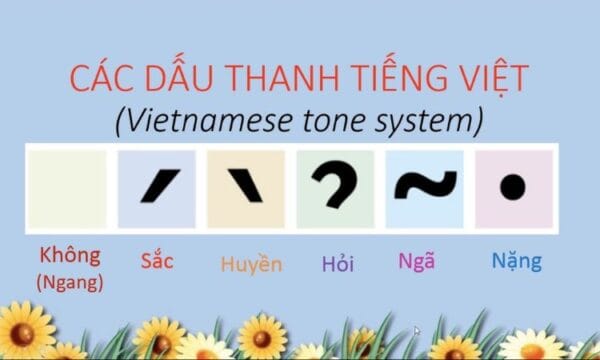
The six Vietnamese tones are not merely six different volume levels (higher or lower). Each tone possesses its own specific trajectory—the required movement of your vocal cords during pronunciation:
| Tone | Mark | Pitch Trajectory | Example |
|---|---|---|---|
| Flat (Bằng) | No mark | Flat and sustained | ma |
| Falling (Huyền) | Mark ` | Drops low and trails off | mà |
| Rising (Sắc) | Mark ´ | Spikes high and short | má |
| Heavy (Nặng) | Mark . | Drops sharply and heavily | mạ |
| Asking (Hỏi) | Mark ? | Dips down then rises (like a question) | mả |
| Tumbling (Ngã) | Mark ~ | Rises, breaks briefly, then rises again | mã |
Native speakers from Northern Vietnam execute and differentiate all six tones flawlessly. Native speakers from the South typically merge the "asking" (?) and "tumbling" (~) tones—meaning the Southern dialect realistically only utilizes five distinct tones in daily operation.
The good news: The Vietnamese are spectacularly patient with foreigners attempting to speak their language. If you butcher a tone, they will reverse-engineer what you intended to say based on context—and they will smile.
The Mechanics That Are Actually Easier Than You Think

Despite the terror of the tonal system, Vietnamese possesses structural elements that are massively simpler than most other languages:
Zero Verb Conjugation: In English: I go, she goes, I went. In Vietnamese: tôi đi (I go), cô ấy đi (she go), tôi đi hôm qua (I go yesterday). The verb never mutates. Tense is engineered by simply inserting a time marker (yesterday, today, tomorrow)—not by destroying and rebuilding the verb.
Zero Noun Pluralization: One table—many table—it remains "bàn." Plurality is indicated by simply attaching a quantity word.
Zero Gender: Numerous European and Arabic languages assign male/female genders to inanimate objects. Vietnamese completely lacks this concept.
The Latin Script: You do not have to memorize thousands of complex characters like Japanese, Korean, or Chinese. The letters are visually familiar—only the diacritics are alien.
High-Yield Phrases for Week One
These are the specific phrases that will immediately generate a highly positive reaction from the Vietnamese—even if your pronunciation is flawed:
"Xin chào!" — Hello (general greeting). Foreigners use "Xin chào" constantly—though locals typically use "Chào anh/chị/em..." based on age hierarchy.
"Cảm ơn!" — Thank you. Simple, effective, universally understood.
"Xin lỗi!" — Sorry / Excuse me. Deployed when you bump into someone or require their attention.
"Bao nhiêu tiền?" — How much does this cost? You will deploy this hourly.
"Ngon quá!" — Delicious! — If a local cooks for you, this is mathematically the best sequence of sounds you can produce.
"Không cay!" or "Cho ít cay thôi!" — No spice! / Just a little spice! — A critical survival phrase if your biology cannot process heavy chili.
Why You Should Learn It, Even Just a Little

The Vietnamese possess a very specific, almost universal reaction when a foreigner speaks their language—even if it's only three words: they immediately light up.
It is not because Vietnamese is impossibly hard and they are merely impressed (though that is partially true). It is because speaking the language broadcasts a massive signal: "I expended the effort to learn your code. I respect your culture enough to try."
In a world where tourists frequently arrive in Vietnam and arrogantly expect the entire population to accommodate their English—executing the reverse, even on a micro-scale, is immediately recognized and highly valued.
You do not need to operate with flawless fluency. Deploying a few sentences with broken pronunciation and a genuine smile—that is sufficient to instantly alter the temperature of the interaction from a sterile transaction to genuine warmth.
Vietnamese is not an easy language. But there are very few languages on the planet where acquiring such a small amount yields such a massive social ROI.