Traditional Craft Villages — The Hands That Are Holding Onto the Past
Hundreds of craft villages scattered across the nation — each possessing proprietary techniques accumulated over generations. And many of them are slowly vanishing
In the silk village of Van Phuc, Ha Dong, there are still artisans weaving exactly as their ancestors did over a thousand years ago. It is not because they are ignorant of industrial weaving machinery. It is because Van Phuc silk woven via that specific methodology—utilizing a wooden loom, with human hands micro-adjusting every single thread—achieves a texture and optical sheen that absolutely no machine can perfectly replicate.
The operational secret is not documented in a manual. It resides entirely within the biology of the artisan—in the wrist that calculates the exact required tension, in the ear that detects the acoustic frequency of the loom operating correctly, in the eye that evaluates the color saturation under natural sunlight.
That specific data cannot be downloaded from a YouTube tutorial. It is acquired exclusively by sitting adjacent to a master, executing the task tens of thousands of times, until the sequence becomes hardwired into your nervous system.
The Craft Village Map — Regional Specialization
Vietnam hosts over 5,400 craft villages—a massive number indicating that virtually every geographic sector developed a highly specialized skill based on its specific natural resources and historical parameters:
The North: - Bat Trang (Hanoi): Ceramics and pottery — operational since the 14th–15th centuries, historically supplying the imperial court. - Van Phuc (Ha Dong): Silk — engineering a specific optical sheen utilizing techniques refined over 1,000 years. - Dong Ky (Bac Ninh): Fine wooden furniture — executing hyper-complex carving, heavily exported to China. - Dong Ho (Bac Ninh): Woodblock folk paintings — (detailed in a previous chapter).
The Center: - Non Nuoc Stone Village (Da Nang): Stone sculpture — engineering massive stone statues, specifically carrying the DNA of ancient Cham art. - Kim Bong Carpentry Village (Hoi An): Woodworking — historically supplied the architectural timber required to construct the ancient town of Hoi An.
The South: - The Amphibious Villages of Ben Tre: Weaving rattan, coconut leaves, and engineering coconut-based handicrafts — a massive export operation. - Binh Duong Lacquerware Village: Engineering high-end lacquer art and furniture — heavily exported.
The Succession Crisis — When the Youth Refuse to Stay
The supreme existential threat to Vietnamese craft villages today is not cheap industrial competition from China (although that is a severe factor). The ultimate threat is: the younger generation structurally refuses to learn the trade.
The logic is brutally pragmatic: The financial yield from traditional handicrafts cannot compete with corporate office salaries or modern factory wages. The training timeline is massive—requiring several years to a decade to achieve mastery. The physical labor is punishing. And—most critically—even upon reaching apex mastery, the financial compensation frequently does not scale with the skill level.
The mathematical result: in numerous villages, the absolute best artisans are 60–70 years old. When their biological clock runs out, that specific technique will be deleted from existence.
This is not uniquely a Vietnamese narrative—traditional crafts are vanishing across Asia and Europe at terrifying velocity. But in Vietnam, where the craft village is inextricably linked to localized cultural identity, that deletion feels particularly visceral.
Salvation via Storytelling and E-Commerce
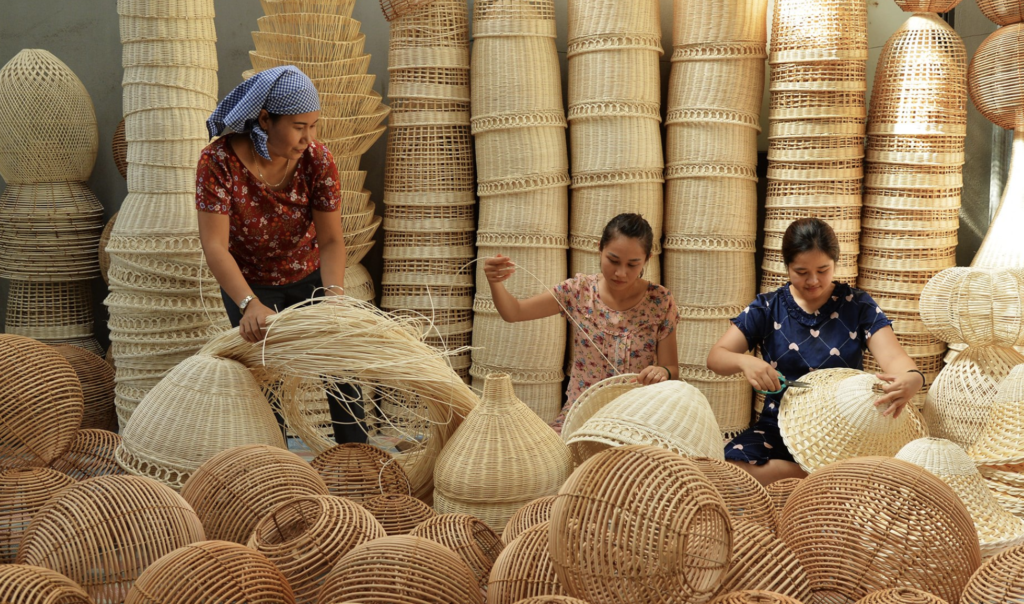
However, the telemetry is not entirely pessimistic. Several rescue vectors are currently activating:
Experiential Tourism: Tourists—both domestic and international—increasingly desire to penetrate the craft villages, observe the manufacturing process, and physically participate. This generates a secondary revenue stream and provides massive organic marketing.
E-Commerce: Platforms like Shopee, Lazada, and specifically Instagram and TikTok are permitting young Vietnamese artisans to sell directly to the end consumer—bypassing the distributors. Some young artisans are learning the trade from their grandparents, then deploying social media to engineer proprietary brands and export globally without intermediaries.
Modern Redesign: Numerous domestic Vietnamese brands are partnering with craft villages to engineer products that fuse traditional techniques with hyper-modern design—Bat Trang ceramics that rival high-end European studio pottery, or Van Phuc silk tailored into avant-garde fashion.
It is structurally impossible to save everything. Not every craft village will survive the 21st century. But the ones that possess individuals willing to broadcast their story, willing to alter the components that require alteration while violently protecting the core—those operations have a statistical probability of survival.
And occasionally, all it requires is a single young individual making the decision to remain in the village, acquire their grandparents' source code, and port it into the modern era—and that is sufficient to prevent an entire skill from being permanently deleted.