Haggling, Bowing, and Business Cards: Communication Etiquette
How to survive in a chaotic wet market and simultaneously secure points in a formal corporate boardroom
Communication in Vietnam is a multi-act theatrical production. On the street level, it is loud, chaotic, and heavily saturated with emotion. Within the corporate boardroom, it transforms into a highly sophisticated dance revolving entirely around the concept of "Face" (Thể diện).
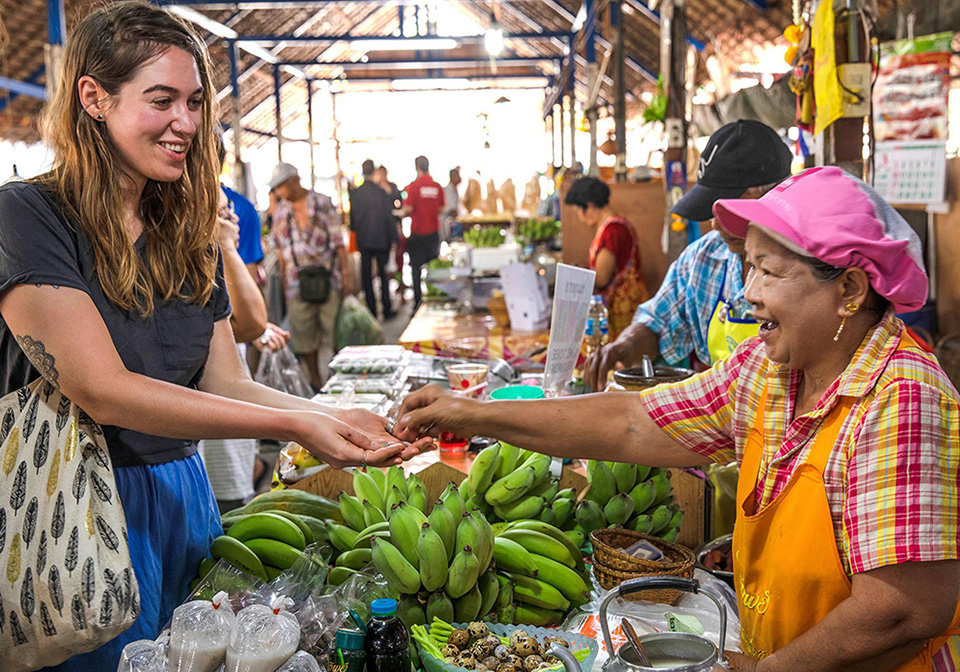
To prevent getting financially routed at Ben Thanh Market and to avoid freezing up during a high-stakes meeting in District 1, you must master these two extreme ends of the communication spectrum.
1. The Art of Market Negotiation (Haggling)
At traditional wet markets, "nói thách" (quoting a price vastly higher than the actual value) is not processed as a scam. It is the fundamental rule of the game.
- Initialize with a Smile: Do not deploy an angry scowl when you intercept an astronomical price quote. Simply smile and state: "Đắt quá, giảm giá đi cô!" (Too expensive, lower the price, auntie!).
- The 50% Protocol: The standard heuristic is to counter-offer at approximately 40-50% of the initial quote, then incrementally increase the value until both parties sync in the middle.
- The "Walk Away" Maneuver: If the vendor refuses to lower the price to your target, express gratitude and turn your back. In 80% of scenarios, they will immediately hail you back with a superior offer. If they do not hail you back, that confirms you hit the absolute price floor.
Critical Warning: Absolutely never haggle early in the morning (specifically if you are the first customer of the day). Vendors operate under the superstition that failing to close the first transaction will curse their revenue stream for the entire day.
2. Polite Communication & The Bowing Protocol
Unlike the protocols in Japan or South Korea, the Vietnamese do not execute a 90-degree bow.
- The standard greeting protocol is a slight nod accompanied by a smile, and the phrase "Xin chào".
- When a younger unit greets an elder, they will frequently cross their arms over their chest and execute a slight bow of the head. This is the ultimate physical manifestation of obedience and deep respect. As a foreign entity, you are not required to cross your arms; merely executing the slight head bow is more than sufficient to trigger a highly appreciative reaction.
3. Corporate Etiquette (The Business Card Exchange)
If your objective in Vietnam is commercial, the exact moment you exchange a Business Card (Danh thiếp) carries vastly more gravity than you realize. It is not merely a piece of paper containing data; it physically represents the status and identity of the individual.
- Transmit and Receive Utilizing Both Hands: Always handle a business card deploying both hands.
- Allocate 3 Seconds for Visual Processing: Do not instantly shove the card into your pocket! Hold it, visually scan the name and the title, execute a slight nod to confirm you have registered their status, and then formally place it on the table (if you are in a meeting) or carefully secure it in a specialized cardholder.
- Do Not Write on the Card: Unless it is an absolute operational necessity, scribbling notes directly onto someone else's business card in their presence is processed as a severe lack of respect.
Conclusion
Whether you are haggling over a bundle of vegetables or signing a multi-million dollar contract, the core operating principle of the Vietnamese remains identical: Emotion leads, logic follows. Preserve the "face" of the opposing party, execute your communication with absolute sincerity and a warm smile, and you will successfully bypass virtually any cultural firewall.