Vietnamese Coffee — It Is Not a Beverage. It Is a Lifestyle
Why does the second-largest coffee exporter on the planet possess a coffee culture that looks, tastes, and functions unlike anywhere else in the world?
There is a specific reality regarding Vietnamese coffee that foreigners are almost never psychologically prepared for the first time they consume it: It is violently stronger than you think.
It is not "slightly strong." It is not "quite robust." It is a liquid so dense and viscous that a spoon stuck into it could practically stand upright—especially if it is an authentic, Saigon-style phin drip coffee.
That tiny glass resting on the sidewalk table—it looks like a meager, insignificant serving—but once you consume it, your heart rate will elevate significantly above baseline for anywhere from 30 minutes to two hours, depending entirely on your central nervous system's tolerance for caffeine.
The Vietnamese consume this substance every single morning. Frequently every afternoon. Occasionally both. And that specific event—the act of sitting down, watching the dark liquid slowly drip from the metal filter, staring blankly at the street traffic, and doing absolutely nothing else—is one of the most critical, stabilizing moments of their entire day.
From Colonial Crop to National Identity — The Journey of the Bean
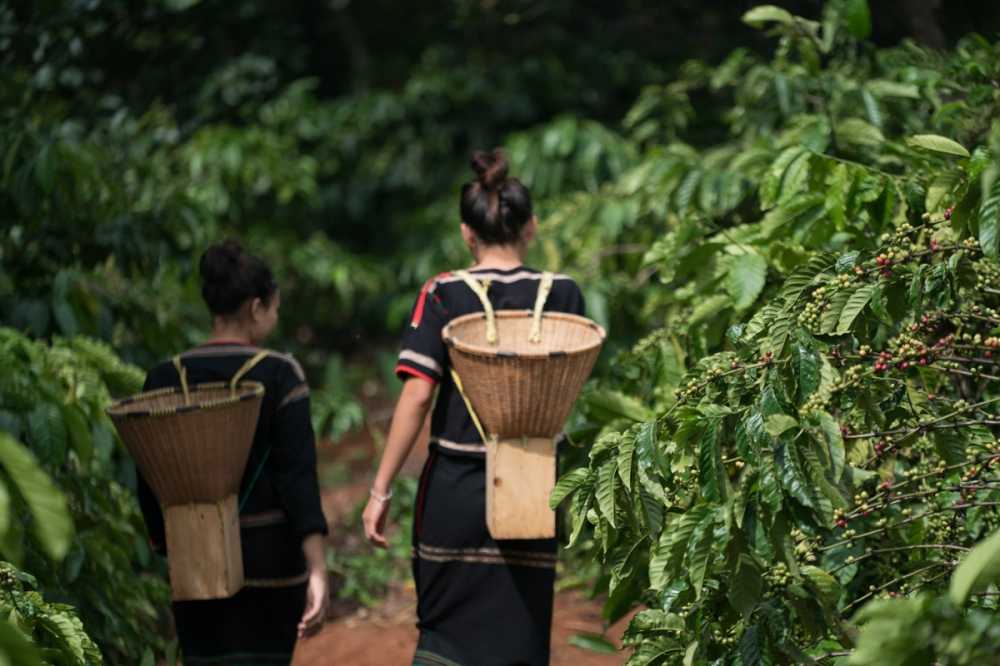
The French dragged the coffee plant into Vietnam in 1857—initially attempting to cultivate it in the North (Tonkin), before eventually relocating operations to the Central Highlands once they realized the volcanic soil and altitude were spectacularly suited for it.
They originally planted Arabica—the bean that dominates Western coffee culture. But Arabica is fragile, demanding, and highly susceptible to disease in the aggressive Vietnamese climate. Robusta—a bean that is violently tougher, vastly more disease-resistant, and significantly harsher in flavor—eventually conquered the Vietnamese agricultural landscape.
And that single agricultural pivot permanently engineered the flavor profile of the entire Vietnamese coffee culture: it is more bitter, vastly more intense, and harbors a much higher caffeine payload than the coffee consumed in Europe or the United States.
The French eventually left. The coffee trees remained. And the Vietnamese did exactly what they have done throughout their history: they seized something imposed upon them by an external force, violently adapted it into their own image, and elevated it to a realm the original colonizers could never have possibly imagined.
The Phin Filter — The Simplest Invention Engineering the Greatest Result
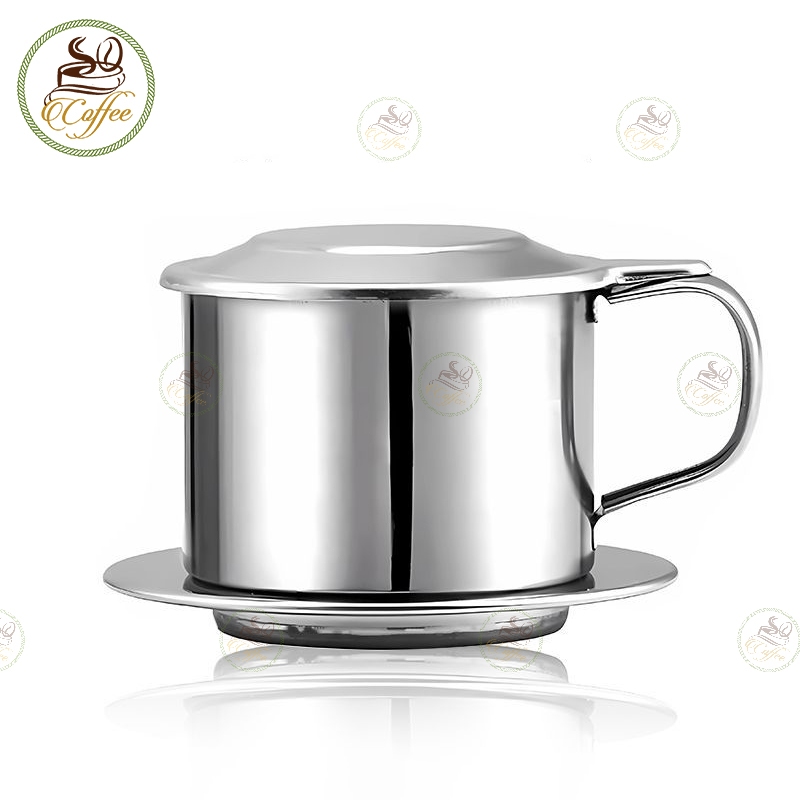
The phin is the most brutally simple coffee brewing apparatus imaginable: a tiny stainless steel or aluminum chamber placed over a glass, loaded with coarse coffee grounds, flooded with boiling water, capped with a lid, and abandoned.
There is no complex, multi-thousand-dollar espresso machine. There is no aeropress or V60 demanded by specialty coffee snobs. It is merely metal, boiling water, and coffee grounds—extracting drop by agonizing drop, slowly, patiently, requiring 5 to 10 minutes to complete.
And here is the bizarre reality: the phin engineers a liquid that absolutely no modern, highly calibrated espresso machine can perfectly replicate. A Vietnamese phin extraction possesses a unique, heavy body—vastly thicker than a pour-over but lacking the aggressive, acidic bite of an espresso—delivering a long, lingering finish and a bizarrely sweet aftertaste that defies logical explanation.
Specialty coffee nerds in Tokyo or Copenhagen will analyze these extraction metrics with deadly seriousness and an exhausting vocabulary. The sidewalk vendor in Saigon who has been brewing it since 5:00 AM every day does not care why it tastes spectacular—she only knows that it does.
Cà Phê Sữa Đá (Iced Milk Coffee) — It Is Not What Westerners Think
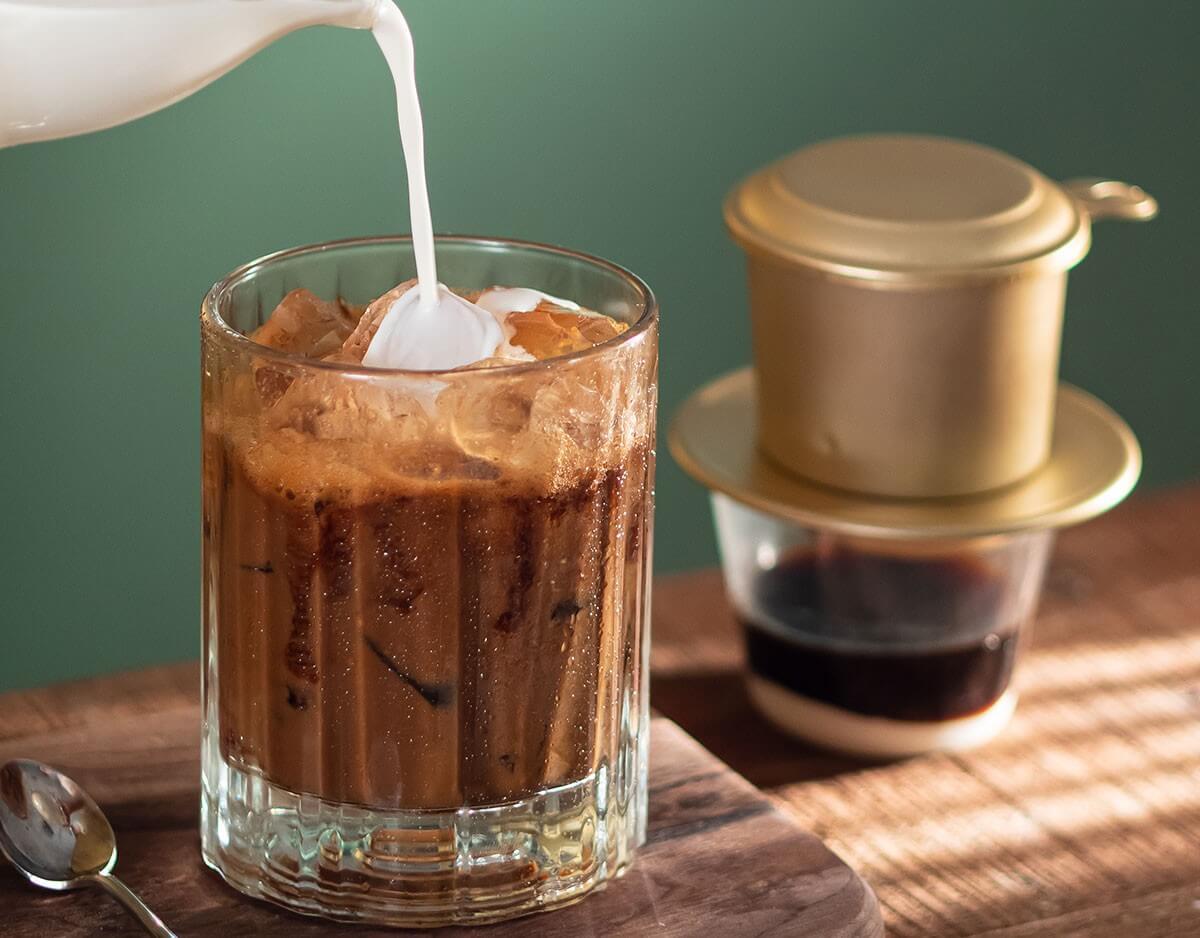
The architectural blueprint of cà phê sữa đá (often called nâu đá in Hanoi) is simple: hyper-dense phin coffee + sweetened condensed milk + chunks of ice.
Those three elements violently collide inside a tall glass—the black stratum of the coffee, the pale yellow stratum of the condensed milk weaving upward, the stark white of the ice—engineering a liquid that is simultaneously bitter and sweet, freezing cold and surprisingly warm (because the freshly extracted coffee is still hot when it hits the ice).
The sweetened condensed milk—not fresh milk—is the critical operative variable. The Vietnamese utilized condensed milk historically because fresh dairy was scarce, expensive, and spoiled rapidly without refrigeration. But that logistical compromise accidentally engineered a flawless flavor pairing: the condensed milk is sweet enough to obliterate the aggressive bitterness of the Robusta, fat enough to construct a velvety body, and dense enough not to dilute the coffee like fresh milk would.
It is a perfect example of historical accident engineering a culinary masterpiece.
Egg Coffee — A Wartime Invention
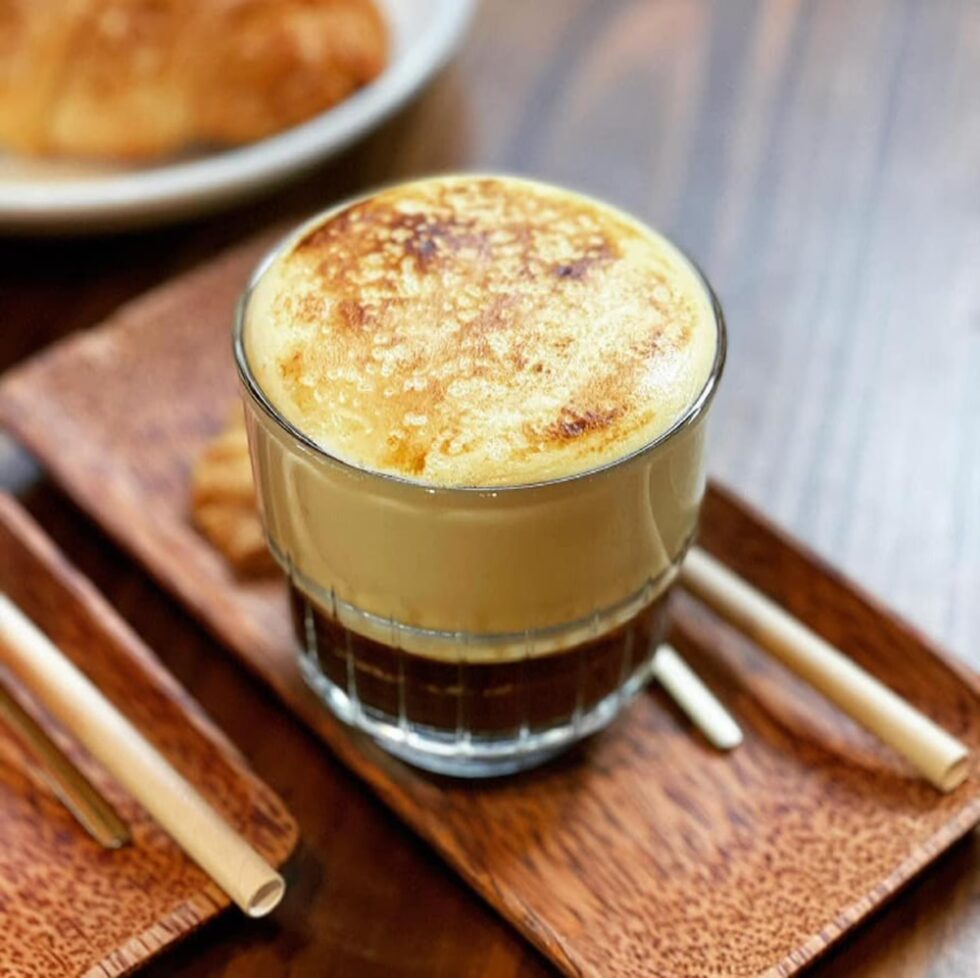
If iced milk coffee is the undisputed icon of the South, then Egg Coffee (cà phê trứng) is the legendary heritage of Hanoi.
The origin story: In 1946, Hanoi was actively under siege. Milk was completely unavailable. Nguyen Van Giang—a bartender operating at the elite Sofitel Metropole Hotel at the time—began desperately experimenting with egg yolks as a substitute for dairy in his coffee.
The resulting mechanics: whipping raw egg yolks with sweetened condensed milk and sugar until it transforms into a dense, airy, meringue-like foam, which is then poured over a base of boiling hot, jet-black coffee—creating a golden, luminous layer of egg cream floating on the surface.
That foam layer is sweet, rich, and incredibly light—consumed alongside the bitter black coffee beneath it by dipping a spoon vertically through the layers, never stirring it—engineering a texture and flavor profile that exists nowhere else on earth.
Over 70 years later, Giang's descendants still operate the original egg coffee cafes in Hanoi. And today, egg coffee is regularly featured in the New York Times, The Guardian, and Condé Nast Traveler as an absolute mandatory requirement for anyone visiting Vietnam.
An invention born of wartime desperation. A heritage of the century.
The Sidewalk Cafe — Where Vietnamese Coffee Culture Actually Breathes
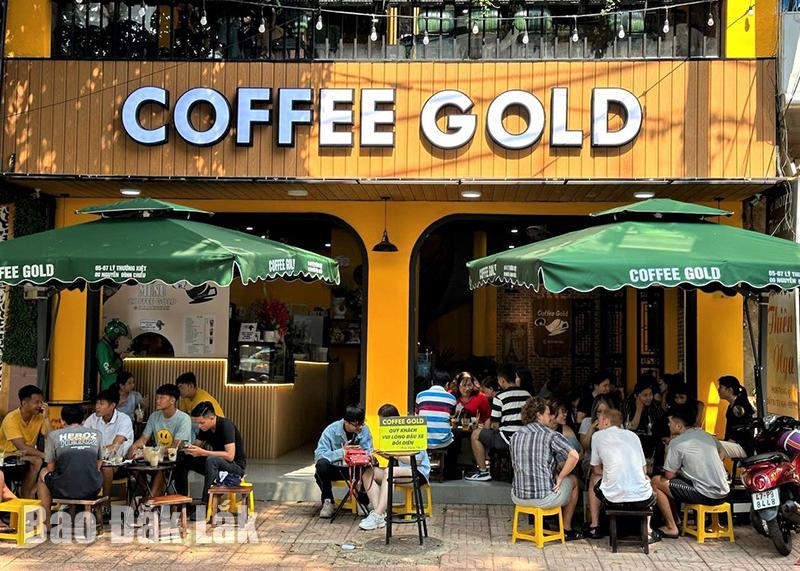
You can absolutely consume Vietnamese coffee inside a hyper-modern, air-conditioned cafe featuring pastel velvet sofas and a curated lo-fi hip-hop playlist. That is not incorrect. But that is absolutely not where Vietnamese coffee culture actually lives.
The true arena is the sidewalk (vỉa hè)—sitting on a plastic stool so absurdly low to the ground your knees are near your chest, utilizing a microscopic plastic table just large enough to hold a glass of coffee and a smartphone, staring blankly into the chaotic river of motorbikes, inhaling the exhaust fumes, and listening to the deafening symphony of horns and street vendors shouting from across the avenue.
A glass of coffee in that specific environment costs roughly 10,000–20,000 VND ($0.50-$1.00). The allotted time limit for occupying that stool: nonexistent. You can sit there for one hour, two hours, three hours—absolutely no one will ask you to leave. When you are sitting there, you are engaging in the act of "ngồi cà phê" (sitting coffee)—you are not merely drinking a beverage; you are occupying its space.
Foreign tourists are frequently deeply confused when they observe the Vietnamese sitting at a cafe, staring at the street, and doing absolutely nothing. Not reading a book. Not scrolling through their phones. Just sitting.
But that, in reality, is one of the most difficult skills to master in the modern, hyper-connected world: Sitting entirely still and simply existing in the present moment. The Vietnamese possess a specific phrase for that exact state—"ngồi cà phê"—as if sitting completely still with a cup of coffee is a fully realized, comprehensive activity that requires absolutely no further input or distraction.
And perhaps, that is the most profound, sophisticated street-level wisdom of them all.
Coffee is a Social Language
In Vietnam, inviting someone to "đi cà phê" (go for coffee) is never simply a request to ingest a caffeinated beverage. It is a coded transmission that actually translates to:
"I want to dedicate time to you." "I need to have a serious conversation with you." "I need to seek your counsel regarding a crisis." "I miss you."
Millions of the most critical conversations in Vietnamese society—the initiation of romances, the closing of massive business deals, the mediation of brutal family conflicts, the reconnection of long-lost friends—do not occur in boardrooms or formal living rooms. They occur on tiny plastic stools, over glasses of iced milk coffee or bitter black Robusta, on the sidewalks of Hanoi, Saigon, or any provincial town in Vietnam.
Coffee is not the excuse for the meeting. Coffee is the meeting.